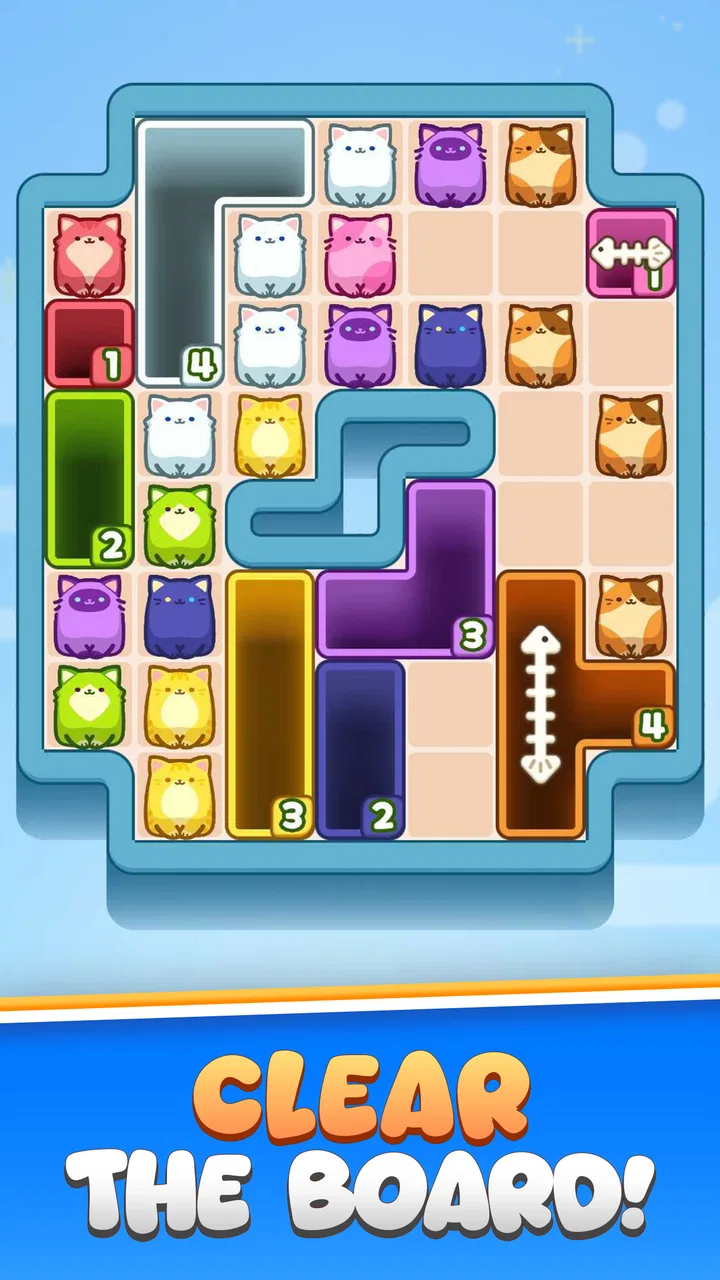
Drop the Cat!
- 4.1
- Rating
- 1.00M
- Installs
- Free
- Price

 Analysis by App-foxy
I approached Drop the Cat! as the kind of casual game you open when you want a quick mental break rather than a long session. Its central idea is immediately readable: drop the cat, watch how the pieces settle, and try to make choices that lead to a satisfying result. That simplicity is the main attraction. I did not need a long explanation before starting, and the game feels approachable even if you rarely play puzzle games.
At the same time, the short concept should not be mistaken for a completely empty experience. The challenge comes from looking at the space before acting, judging how the cat will land, and resisting the temptation to make a move just because it is available. The best moments are not about speed. They come from noticing a better position a second before committing.
Around a million people have installed this free casual game, and its average rating sits at 4.3 from roughly thirty-five thousand ratings. That gives me a useful impression of its audience: it is easy enough to attract occasional players, but it still offers enough repeat value for people who enjoy small, low-pressure challenges. ACTIONFIT has kept the presentation focused on the drop mechanic instead of burying it under a complicated interface.
You May Also Like

 Blood Strike: 2.5 Anniversary
Blood Strike’s Loadouts Turn Every Drop Into a Tactical Gamble
A close look at Blood Strike’s custom loadouts: how fast access to signature weapons reshapes its battle royale rhythm, rewards preparation, and narrows the gap between fights.

 Pandora - Music & Podcasts
Pandora’s Music Is Easy to Start, but Harder to Recover
Pandora’s strength is its low-effort path from a seed to a station. Its weak spot is how much confidence it asks you to place in connection, setup, and quiet recovery.

 8 Ball Pool
 Is Built on Rivalries, Rematches, and Routine
A close look at the rivalries, rematches, shared routines, and unanswered safety questions that turn a quick pool match into a persistent mobile community.

 Samsung Music
’s Quiet Strength Is Playing What You Already Own
Its reach comes less from spectacle than from dependable access to a personal library. That simplicity is both the app’s strongest retention engine and its ceiling.

 AccuWeather: Weather Radar
AccuWeather Review: A Quick, Clear Forecast for Everyday Decisions
For everyday plans, the best forecast is the one you can understand quickly. AccuWeather makes rain timing, radar, and local conditions easy to act on, with a few trade-offs.

 Hill Climb Racing
Why Hill Climb Racing Still Turns Crashes Into One More Run
A tiny car, a bumpy hill and one more upgrade: Hill Climb Racing keeps resurfacing because its simple chaos makes every near-miss feel personal.
More From Our News Desk
View All News


What the first few minutes feel like
When I start a session, I expect a compact loop rather than a story-driven adventure or a collection of unrelated modes. The game asks me to pay attention to the arrangement in front of me, make a drop, and learn from the result. That makes it suitable for short gaps in the day, such as waiting for an appointment, taking a break between tasks, or winding down before sleep.
The first meaningful success is usually less dramatic than completing a long level in a traditional puzzle game, but that is part of the appeal. I get a small sense of control from choosing when to act and seeing the result unfold. If the placement works, I can immediately understand why. If it fails, the mistake is also easy to examine instead of feeling random or overly punishing.
For a first-time player, I recommend treating the opening attempts as practice rather than chasing a perfect result. Look at the available space, identify where the cat is most likely to settle, and think about what the next position might look like. This habit is more useful than tapping quickly. The game rewards a calm eye, especially when the obvious opening is not the safest one.
One detail I found valuable is that the game naturally encourages a pause before every action. In many casual titles, the player can rush through the opening seconds and rely on repetition. Here, that approach can hide the real decision. Taking a moment to inspect the layout turns a simple drop into a small planning exercise, which is where the brain-training angle becomes believable in everyday use.
Getting comfortable without overthinking it
I would not install this expecting a deep tutorial or a large rulebook. Its strength is that the basic action is understandable on sight. The most useful preparation is simply to notice how the cat reacts after a drop and how much room remains for later choices. That observation gives more practical information than memorizing instructions.
A good early routine is to make one deliberate move, watch the outcome, and then decide whether the next action should preserve space or pursue a more immediate gain. This is a small but important trade-off. A move that looks successful now may leave an awkward arrangement afterward, while a less exciting placement can keep future options open.
That makes the game more interesting for players who enjoy spatial thinking but do not want the pressure of a timer-heavy arcade title. It also explains why I would recommend it to someone who likes casual puzzles but often abandons games that demand a long uninterrupted session. Each attempt can be short, yet the decision-making still feels personal.
How to reach the first satisfying result
My practical advice for a new player is to stop treating every opening as a race. Before dropping the cat, scan for the area that gives the most room to recover. The safest-looking position is not always the one directly beneath the starting point. If the layout allows it, I prefer a placement that keeps the center or a broad open section available for the next decision.
After the first drop, do not immediately repeat the same gesture. Check what changed. A successful landing may alter the balance of the remaining space, and the next move should respond to that new arrangement rather than follow a fixed pattern. This is one of the first non-obvious lessons in the game: the best strategy is reactive, not memorized.
When a move goes badly, I find it more useful to ask what I overlooked than to blame the result on luck. Did I leave a narrow gap? Did I use a flexible position too early? Did I focus on the cat itself and ignore the space it would occupy afterward? Those questions turn a failed attempt into a quick learning cycle.
For a realistic everyday example, imagine opening the game during a five-minute coffee break. I would play one or two attempts, concentrating on making a careful first drop rather than trying to clear everything. If a result feels messy, I would stop there instead of forcing a long session. The game works best as a compact reset, not as something that needs to take over the entire break.
Where new players can become confused
The biggest source of confusion is the gap between understanding the instruction and understanding the consequences. “Drop the Cat!” sounds obvious, but the useful question is not merely where the cat can go. It is where that placement leaves the next decision. Beginners may focus on the immediate landing and overlook how quickly a promising area can become difficult to use.
Another common mistake is assuming that a visually open route is automatically the best route. I found that open space has value because it preserves options, not because it guarantees a good outcome. Sometimes a controlled, less spectacular placement is preferable when it avoids creating a cramped follow-up.
Players may also wonder whether the game is meant to be played quickly. My answer is no, at least not if the goal is to improve. A fast tap can be entertaining for a moment, but thoughtful timing is what gives the mechanic its puzzle character. If you prefer instant reactions and constant movement, this may feel too restrained. If you enjoy checking a position before acting, that slower rhythm is a strength.
The game is rated Everyone, so it is an accessible choice for a broad audience. Still, accessibility of the rules does not mean every player will enjoy the same pace. Children may like the cat and the simple action, while adults may appreciate the quiet spatial challenge. I would introduce it to a younger player by encouraging observation rather than emphasizing scores or repeated failure.
What makes it different from familiar casual alternatives
Compared with match-three games, this title feels less dependent on scanning for colorful combinations and more dependent on placement. It does not give me the same chain-reaction satisfaction as a typical matching game, but it also avoids the visual clutter that can make those games tiring. The focus stays on one clear decision at a time.
Compared with endless runners, it is much less demanding physically and mentally in the moment. There is no reason to keep reacting at high speed. That makes it a better fit for relaxed play, though a worse fit for someone who wants constant motion or a strong adrenaline loop.
It also differs from larger puzzle games that build elaborate campaigns around dozens of rules. Here, the appeal is the narrowness of the idea. I can understand the basic action quickly, then spend time improving my judgment within that framework. The trade-off is variety: players seeking different puzzle types, a story, or a broad progression system may find the experience too focused.
That focused design is also why I would not recommend it as a replacement for a serious strategy game. The decisions are small and immediate rather than part of a large system. It is better viewed as a pocket-sized exercise in spatial awareness than as a full strategic experience.
Playing free and deciding whether to spend
The game is free to download, which makes trying it straightforward. It includes optional in-app purchases ranging from $1.99 to $109.99 per item. That wide range is worth noticing before playing, especially if the device is shared with a child or if you prefer to keep casual games completely cost-free.
My advice is to begin without spending and first decide whether the basic drop-and-plan loop holds your attention. A purchase only makes sense if it addresses something you genuinely want during play, rather than being an automatic reaction to a difficult attempt. For a short-session game, I would be particularly cautious about paying simply to rush past a challenge that could teach you a better approach.
Families should also remember that an Everyone rating describes the content audience, not a promise that every purchase decision will be effortless. I would check the device’s purchase controls before handing the game to a child. That is a practical step for any free game with optional paid items, and it avoids turning a harmless trial into an unexpected expense.
Performance expectations and version details
The current version is 1.10.93, and the listed minimum operating-system requirement is Android 10. That makes the compatibility question fairly simple for many Android users: check the device software before installing, particularly if the phone has not been updated in a while. The game is developed by ACTIONFIT, and its casual presentation makes it easy to understand what kind of experience it is offering.
I would not choose this title because of technical ambition. Its value is in quick access, clear interaction, and the small decisions between one drop and the next. That also means expectations matter. If you want advanced graphics, a large narrative, or a long-term competitive system, you should look elsewhere. If you want something that can be understood quickly and revisited in short bursts, the modest scope works in its favor.
One useful habit is to keep sessions intentional. Because the core action is simple, it is easy to repeat attempts without noticing that your attention has dropped. I get better results when I stop after a few careless moves, reset mentally, and return later. This is not a game that benefits from blindly grinding; observation is more valuable than repetition.
Who should try it, and who should skip it
I would recommend Drop the Cat! to players who like casual puzzles, gentle spatial planning, and games that explain themselves through interaction. It is especially suitable for someone who wants a small activity between larger tasks. The cat theme adds personality without requiring a story, while the drop mechanic gives the session a clear purpose from the first attempt.
It is also a good choice for people who enjoy improving through tiny adjustments. You can change the timing of a move, preserve a different area, or reconsider an obvious opening and immediately see whether your thinking helped. That direct connection between decision and result is more satisfying than a game where success feels mostly dependent on random rewards.
I would skip it if your ideal casual game has constant action, elaborate character progression, or a strong social layer. I would also skip it if you dislike repeating a compact mechanic to refine your judgment. The game’s narrow focus is its identity, but it can feel limited when you are looking for variety rather than mastery.
My next-step advice after the first session
Once the basic action feels comfortable, I suggest choosing one improvement goal for the next few attempts. Instead of trying to win immediately, focus on leaving more usable space after the first drop. Then change the goal: look for safer openings, avoid committing too early, or compare the result of a cautious move with a bold one. This turns casual play into a small experiment.
Another useful approach is to notice your own habits. I tend to favor the most obvious opening, so I deliberately pause and inspect alternatives. A different player may rush, repeat a familiar position, or focus too much on the current landing. Identifying that personal pattern is more productive than copying a universal strategy, because the game’s decisions are closely tied to the arrangement in front of you.
After several sessions, you should know whether the loop has enough depth for you. If you enjoy seeing your decisions become more deliberate, keep it as a short daily puzzle. If every attempt feels identical and the simple mechanic no longer holds your attention, there is no reason to force it. Its appeal depends on finding satisfaction in small improvements.
Overall, I see it as a friendly, focused casual game rather than a complete all-purpose entertainment app. The free entry point makes it easy to test, the Everyone rating keeps the concept broadly approachable, and its strongest quality is the way it turns one simple action into a question about space and timing. My recommendation is to play slowly at first, protect your future options, and judge the game by how much you enjoy refining one decision at a time.
FAQs for Drop the Cat!
01What is the main objective of Drop the Cat!?
Drop the Cat! is a physics-based puzzle game where players must strategically drop a cat onto a specific target while overcoming various obstacles. The aim is to use the fewest moves possible, testing your problem-solving skills and precision. The game provides a fun and challenging experience for all ages.
02Is Drop the Cat! suitable for children?
Yes, Drop the Cat! is designed to be family-friendly and suitable for players of all ages. The colorful graphics and straightforward gameplay make it accessible for children, while the increasing difficulty of levels offers a challenge for older players. However, parental guidance is recommended to manage screen time.
03Are there in-app purchases in Drop the Cat!?
Drop the Cat! offers in-app purchases that allow players to buy hints, additional levels, and cosmetic items to customize the game experience. While the game can be enjoyed without spending money, these purchases can enhance gameplay. It’s advisable to monitor and manage in-app purchases, especially if children are playing.
04Does Drop the Cat! require an internet connection to play?
No, Drop the Cat! can be played offline without an internet connection. This makes it a convenient option for gaming on the go. However, an internet connection is required to access certain features, such as updates, leaderboards, and in-app purchases. Make sure to connect periodically to enjoy these features.
05What platforms is Drop the Cat! available on?
Drop the Cat! is available on both Android and iOS platforms. Players can download it from the Google Play Store or the Apple App Store. The game is optimized for a wide range of devices, ensuring smooth performance and compatibility with various screen sizes and operating systems.
Pros
- Challenging puzzles enhance critical thinking.
- Cute graphics and animations are engaging.
- Smooth and intuitive controls for easy play.
- Regular updates with new levels and features.
- Offline mode ensures play without internet.
Cons
- Ads can be frequent and interrupt gameplay.
- Some levels may feel repetitive over time.
- In-app purchases can be pricey for extras.
- Occasional bugs may cause minor crashes.
- Limited hints make difficult levels frustrating.

Drop the Cat!
Gallery